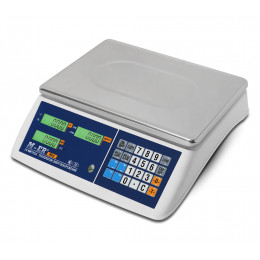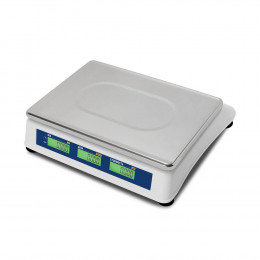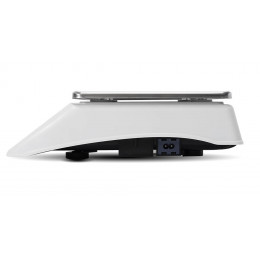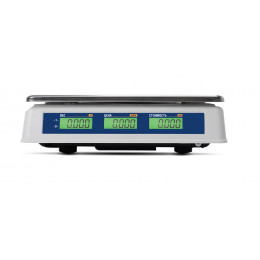
Choosing the right retail weighing scale for your business comes down to three questions: what products you sell, how heavy a typical purchase is, and where the scale will stand. For most grocery stores in Tashkent, a countertop price computing weighing scale with a 15 kg capacity and 2 g readability is enough. Produce sold by the sack, melons and watermelons need a floor scale rated for 60–150 kg. Meat and fish counters need a washdown scale, and supermarkets with self-service need a label printing scale. This guide explains the main types of retail scales, the specs that matter, the requirements for scales in Uzbek stores, and which M-ER models fit each case, with prices in UZS.
Quick answer: which scale fits your store
| Business | Best scale type | Capacity | What to check |
|---|---|---|---|
| Neighborhood grocery store | countertop price computing scale | 15 kg | customer display, price memory, battery |
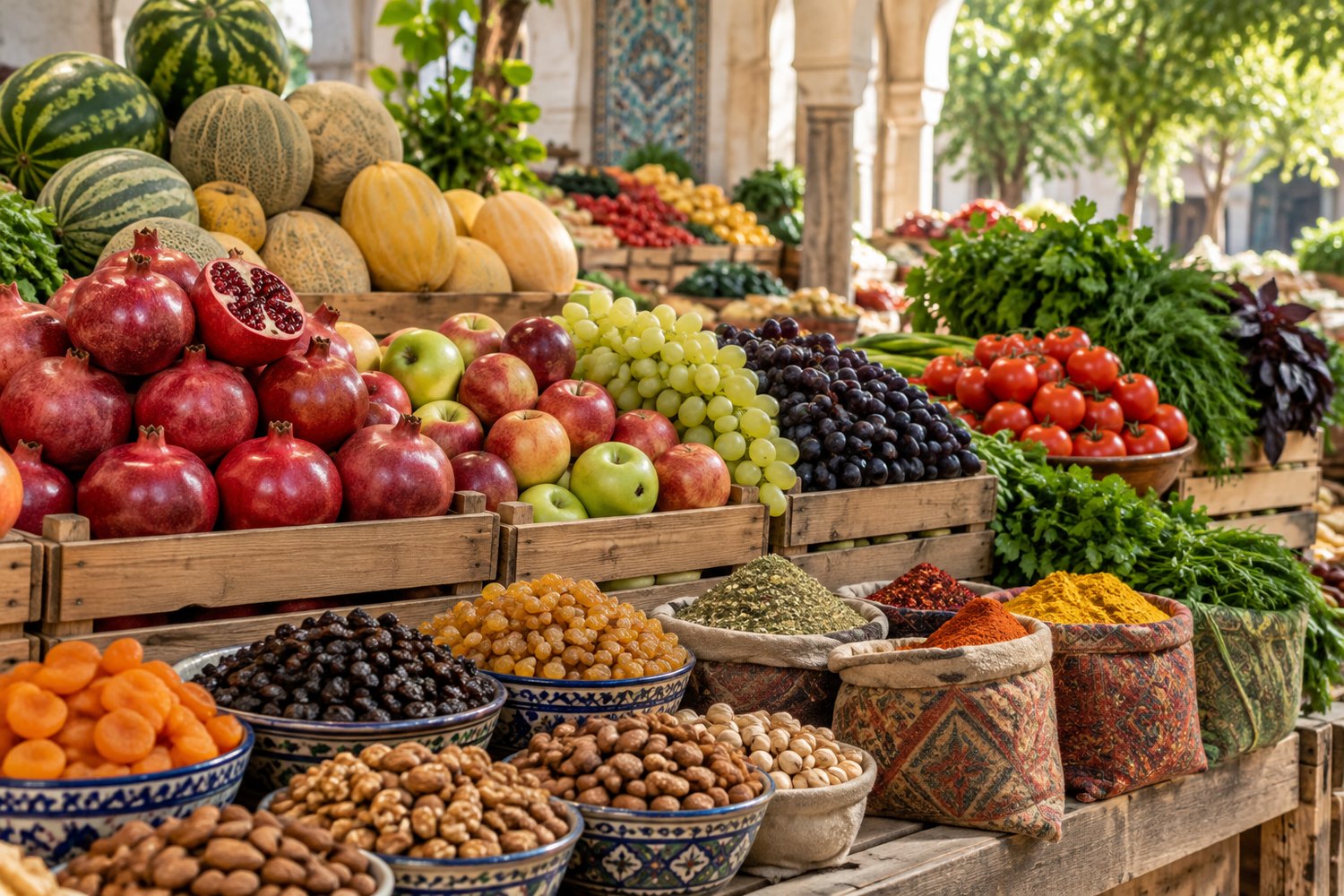
| Fruit and vegetable stall, bazaar | countertop + floor scale | 15 kg and 60–150 kg | bright LED display, battery operation |
| Butcher or fish counter | washdown scale | 15–32 kg | IP67/IP68 rating, stainless steel platter |
| Minimarket checkout | POS interface scale | 6–15 kg | RS-232/USB connection to POS and 1C |
| Supermarket, self-service | label printing scale | 15–32 kg | barcode label printer, network, product database |
| Warehouse, wholesale | floor or platform scale | 150–600 kg | platform size, indicator on a column |
Choose a retail scale by your products, not by price or brand. The heaviest purchase sets the capacity you need, and the lightest one sets the accuracy you need.
You can compare all models in the retail scales category or browse the full range of electronic scales.
Types of retail scales
Retail weighing equipment comes in several types. Knowing the difference helps you avoid paying for features you do not need and buying a scale you cannot legally use for sales.
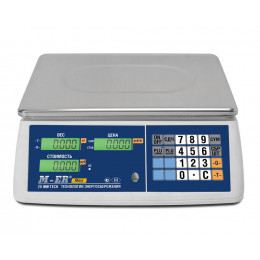
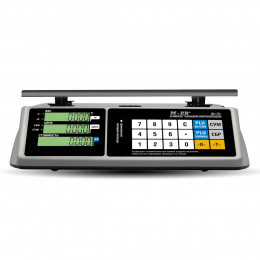
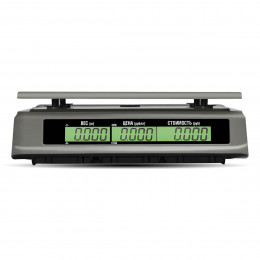
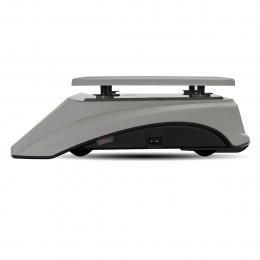
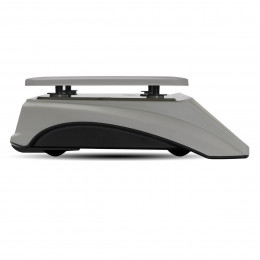
Price computing scales. The standard scale for a sales counter. The cashier enters the price per kilogram, and the scale shows the weight, unit price and total. A second display faces the customer, so they can see the result. This is the type you need wherever products are sold by weight.
Portion and packing scales. Used for pre-packing, kitchens and food production. They usually have one display for the operator and no price calculation. They are useful for packing cheese, sausage or dried fruit, but not for selling to customers at the counter.
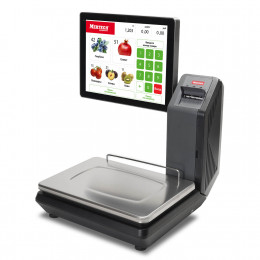
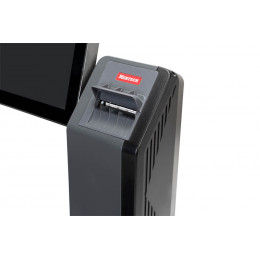
Label printing scales. These scales weigh the product and print a label with the weight, price and a barcode that is scanned at checkout. Supermarkets use them at service counters and in self-service produce areas. Smart scales with AI product recognition use a camera to identify fruit and vegetables automatically, so customers do not need to search for a product code.
POS interface scales. An interface scale sends the weight directly to the POS system, and the checkout software calculates the price and prints the receipt. They are used where the scale sits right at the checkout.
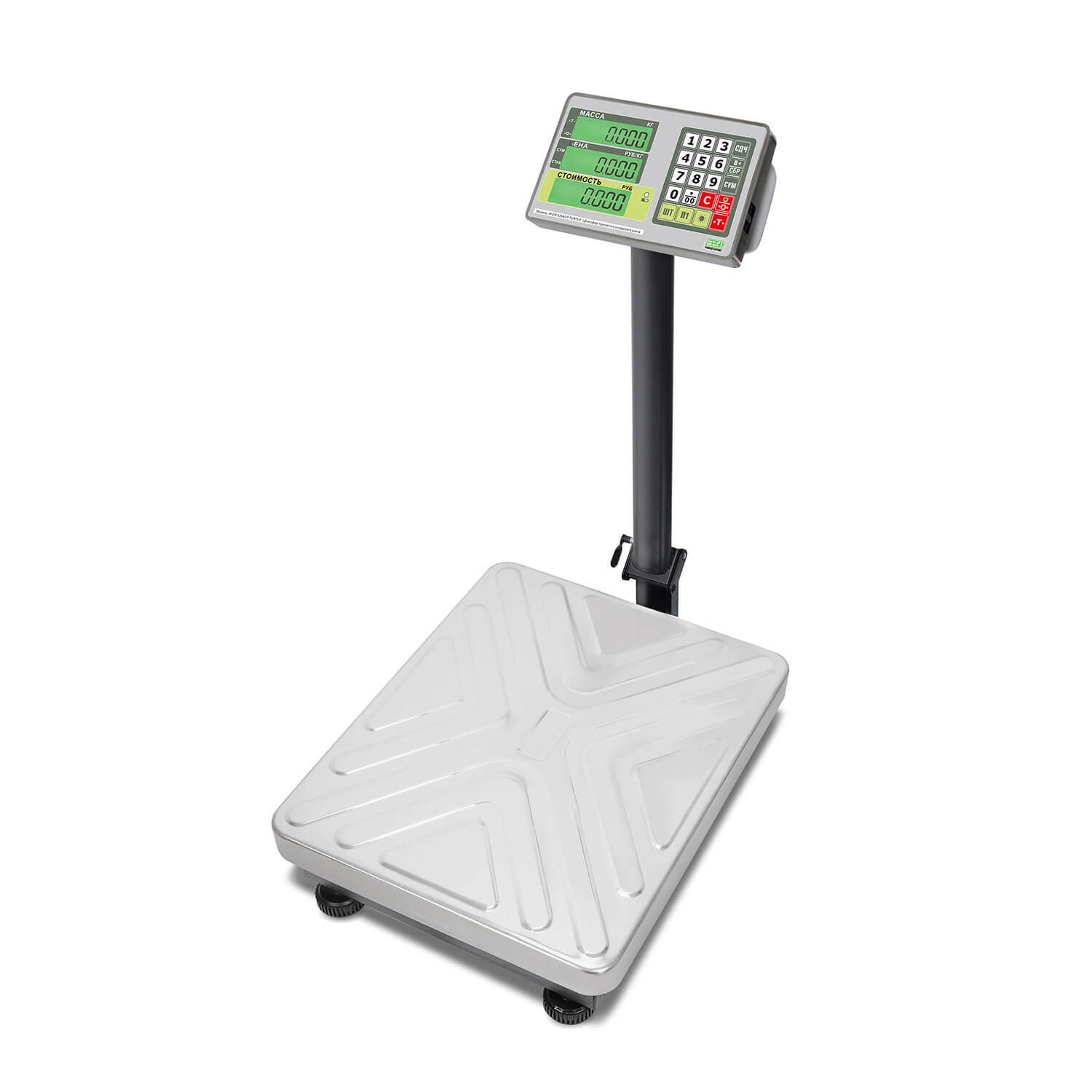
Floor and platform scales. Designed for heavy items: sacks of potatoes, onions or rice, crates of fruit, watermelons. The platform stands on the floor, and the indicator is mounted on a column.
For selling by weight you need a price computing scale with a customer display. Packing scales are fine for preparing products, but not for transactions with customers.
Key specs: capacity, readability, accuracy class
To compare weighing scales, look at five specs. You can find them on every product page.
| Spec | What it means | How to choose |
|---|---|---|
| Maximum capacity | the heaviest load the scale can weigh | 20–30% above your heaviest purchase |
| Minimum weight | the lightest load the scale weighs accurately | below your smallest portion |
| Readability (division) | the smallest step between readings | 1–2 g for spices and sweets, 5 g for produce |
| Accuracy class | permitted error under the OIML classification | Class III for commercial use |
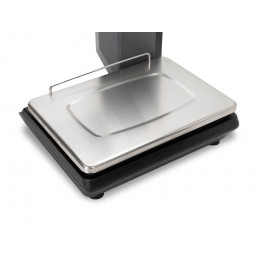
| Platter size | the surface for the product | fits your trays or packages |
Readability is the smallest change the scale can display. With a 2 g division, the scale shows 502 g or 504 g, but never 503 g. The smaller the division, the more accurate the price for expensive products. In M-ER model names, 15.2 means a 15 kg capacity with 2 g readability, and 32.5 means 32 kg with 5 g.
Displays come in LCD and LED. An LCD uses less power and is easy to read indoors. An LED display is brighter and easier to read in direct sunlight or in a dark stall, which makes it a better choice for outdoor markets.
Accurate weighing depends on both the accuracy class and the readability. For saffron, nuts and sweets, choose a scale with 1–2 g divisions. For vegetables, 5–10 g is enough.
Matching capacity to your products
Pick the capacity by the heaviest item you put on the platter in one weighing. Overloading damages the load cell faster than anything else, so your scale should always have a margin.
| Products | Typical purchase | Recommended capacity |
|---|---|---|
| Spices, tea, saffron, dried fruit | 50–500 g | 3–6 kg with 1–2 g readability |
| Sausage, cheese, sweets, bakery | 0.2–3 kg | 6–15 kg |
| Meat, fish, poultry | 0.5–5 kg | 15–32 kg |
| Fruit and vegetables | 1–10 kg | 15–32 kg |
| Watermelons, melons, pumpkins | 5–25 kg | 32–60 kg or a floor scale |
| Potatoes, onions, rice, flour in sacks | 25–50 kg | 60–150 kg floor scale |
For most retail stores, a 15 kg countertop scale is the right choice. If you sell both light and heavy items, two scales work better than one 150 kg model: heavy-duty scales have 20–50 g divisions, which is too coarse for sweets.
Features that speed up checkout
Modern weighing scales do more than weigh. The right features can save your staff seconds on every customer during rush hour.
- Tare subtracts the weight of a bag, tray or container.
- Zero resets the reading if crumbs or water stay on the platter.
- Price memory recalls the price of a popular product with one key.
- Totaling adds up several items for one customer.
- Change calculation shows how much change to give.
- Counting mode counts identical items by weight.
- Battery operation keeps the scale working during power cuts and at outdoor markets. Some M-ER models run up to 4–6 months on one charge.
POS, software and label printer integration
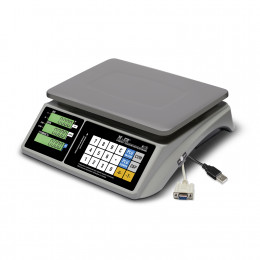
A retail scale is part of your checkout system, together with the POS terminal, barcode scanner, receipt printer and cash drawer. If your store uses checkout software or 1C, choose a scale with RS-232 and USB ports, such as the M-ER 328 TOUCH-M. The weight goes straight into the receipt, and the cashier does not type it by hand.
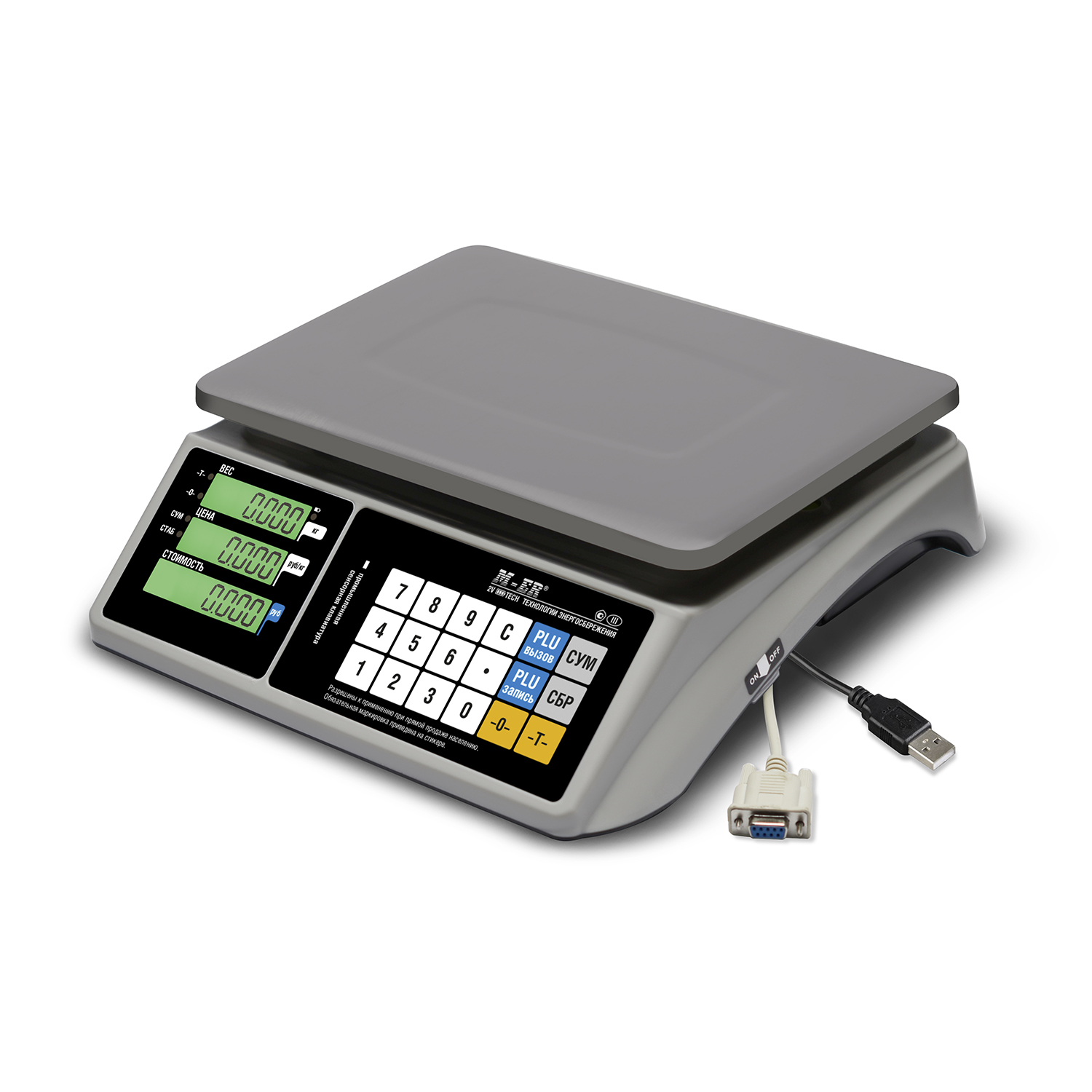
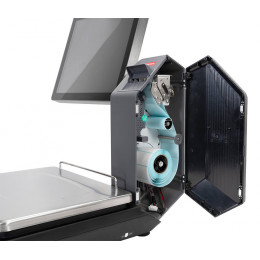
For self-service and pre-packing, a label printing scale with a built-in thermal printer, Wi-Fi and Ethernet connects to your product database. Prices are updated from the back office, and every label carries a barcode that the checkout reads.
Price memory and POS integration cut the time spent on each customer and remove manual entry errors. In a busy store, this matters more than extra kilograms of capacity.
Working environment: water, heat, outdoor use
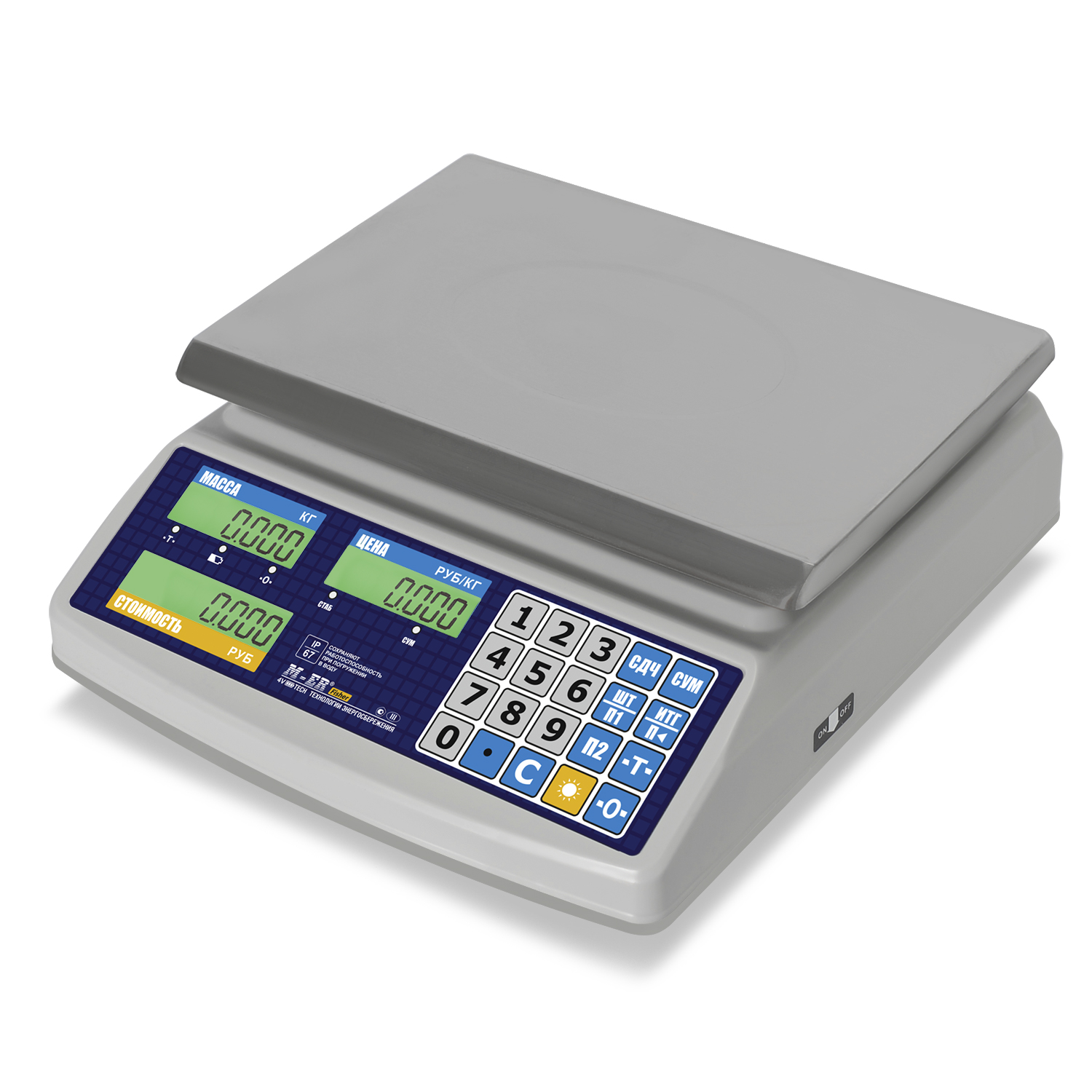
- Meat, fish and poultry. Use washdown scales with an IP67 or IP68 rating and a stainless steel platter, such as the M-ER 329 Fisher. They can be cleaned with water. See also the scales for meat.
- Weighing outdoors at bazaars and stalls. Look for a battery, a bright LED display and a durable housing. Keep the scale out of direct summer sun, because overheating affects readings.
- Cold rooms. Check the operating temperature range. After moving a scale from the cold into a warm room, let it warm up before switching it on.
Legal requirements for scales in Uzbekistan
The Committee for the Development of Competition and Protection of Consumer Rights of Uzbekistan sets these rules for scales in retail stores:
- The scale must be placed so the customer can see the whole weighing process.
- It must not be turned at an angle to the front of the counter or blocked by products, curtains or other objects.
- It must stand on a firm, stable, level surface free from vibration.
- The sales floor must have a control scale in a convenient place where customers can check their purchases.
A scale used for transactions with customers is a measuring instrument and must pass metrological verification in Uzbekistan through accredited services of the O‘zstandart system. In practice, retail scales are verified once a year.
Before you buy, check that the model comes with the documents needed for verification in Uzbekistan. An unverified scale cannot be used for sales, even if it is accurate.
M-ER retail scales and prices
| Model | Type | Capacity / division | Key features | Price, UZS |
|---|---|---|---|---|
| M-ER 326 C-15.2 LCD | countertop | 15 kg / 2 g | mains powered, totaling, 2 price memories | 637,800 |
| M-ER 223 AC-15.2 Mary LCD | countertop | 15 kg / 2 g | up to 6 months on battery, 13 price memories | 723,100 |
| M-ER 326 AC-15.2 Slim LCD | countertop | 15 kg / 2 g | slim housing, power saving mode | 828,500 |
| M-ER 327 AC-15.2 Ceed LCD | countertop | 15 kg / 2 g | up to 4 months on battery, change calculation | 1,009,300 |
| M-ER 328 AC-15.2 TOUCH-M LCD | countertop | 15 kg / 2 g | RS-232 and USB for POS and 1C | 1,199,900 |
| M-ER 329 AC-15.2 Fisher IP68 | washdown | 15 kg / 2 g | IP68 for meat and fish | 1,476,300 |
| M-ER 333 ACPU-60.20 LCD | floor | 60 kg / 20 g | indicator on a column | 1,637,400 |
| M-ER 335 ACP-150.20 TURTLE | floor | 150 kg / 20–50 g | 520×420 mm platform for wholesale | 2,043,500 |
| M-ER 725 PM-15.2 | label printing | 15 kg / 2 g | 15" touchscreen, Wi-Fi, Ethernet | 18,303,000 |
| M-ER 727 PM-15.2 VISION-AI | smart label scale | 15 kg / 2 g | AI camera recognizes produce | 24,163,000 |
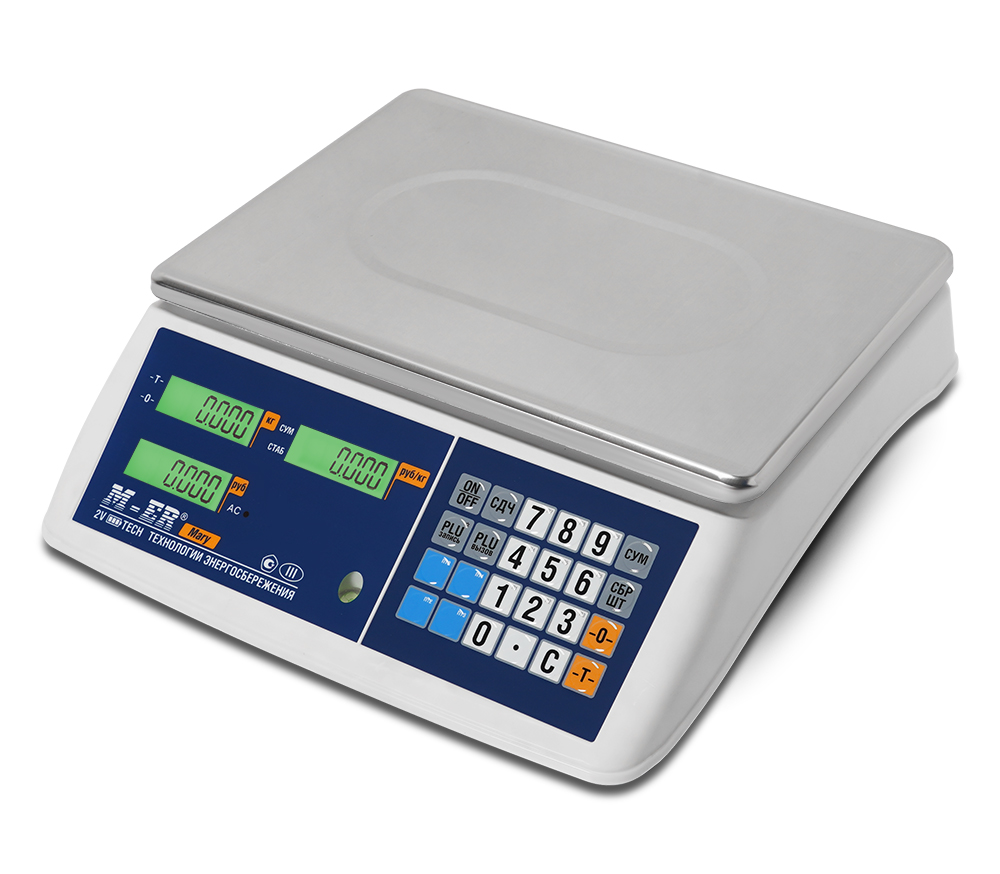
The most popular choice for a neighborhood store in Uzbekistan is a 15 kg countertop scale with a battery and price memory. It covers most retail needs at a moderate price.
For larger stores and self-service, see the label printing scales, and for a full set of retail equipment, the scales for a store collection.
Common mistakes when choosing a scale
Even a good weighing scale will not help if it does not fit your products. Here is what you should avoid.
- Too much capacity. A 150 kg scale has 50 g divisions and prices sweets inaccurately.
- A packing scale instead of a retail scale. It has no customer display and no price calculation.
- A standard scale at the meat counter. Water gets inside, and the scale fails within months.
- An LCD display in direct sun. Customers cannot read it at an outdoor stall.
- No verification. Even a new scale must be verified before you start selling.
- No POS port. If you add checkout software later, you will have to buy a new scale.
- No local warranty and support. Choose a scale with official warranty and service in Uzbekistan.
How to weigh products correctly
- Switch the scale on and wait until it shows zero.
- Check the level bubble: it should be in the center.
- Put an empty container on the platter and press Tare.
- Place the product and wait for a stable weighing result.
- Enter the price or select the product from memory.
- Tell the customer the weight and total shown on their display.
Frequently asked questions
Which scale is best for a grocery store?
A countertop price computing scale with 15 kg capacity, 2–5 g readability, a battery, price memory and a customer display. If you sell produce by the sack, add a 60–150 kg floor scale.
What is the difference between a POS scale and a label printing scale?
A POS scale sends the weight to the checkout software, which prices the item. A label printing scale prices the item itself and prints a barcode label that is scanned at checkout.
Are smart scales with AI recognition worth it?
They pay off in stores with a large produce section and self-service, where finding the product code takes time. For a small store, a standard price computing scale is enough.
How often must retail scales be verified in Uzbekistan?
Retail scales are verified by accredited metrology services of the O‘zstandart system, in practice once a year. The exact interval is stated in the scale documents and the verification certificate.
Which scale should I choose for meat and fish?
Choose a washdown scale with an IP67 or IP68 rating and a stainless steel platter, such as the M-ER 329 Fisher.
LCD or LED display: which is better?
LCD uses less power and works well indoors. LED is brighter and better in sunlight, so it suits outdoor markets.